- Developer
- Miniclip.com
- Installs
- 1B+
- Downloads
- 0
- Views
- 1
- Updated
- Nov 6, 2026
Screenshots
About 8 Ball Pool
8 Ball Pool Complete Guide: Aim, Spin, Cues, Tables, Coins and What to Know Before You Play
8 Ball Pool is Miniclip's 3D online pool game, and it has been one of the most played mobile sports games for well over a decade. You challenge friends and strangers in PvP matches, stake coins on the outcome, upgrade your cue, and climb the league. It is easy to start, difficult to master, and built around a mechanic — aiming with a cue and reading the angles — that rewards understanding rather than reflexes.
What makes the game worth a proper guide is that the difference between a beginner and a strong player is not luck. It is spin control, safety play, cue selection and bank shot knowledge. Most players plateau because they never learn the cue ball's behaviour after contact, never use defensive shots, and never understand why their cue's stats matter.
This guide explains how matches actually work, what the table tiers and coin stakes mean, how cues and their stats affect play, how the league and ranking system functions, what the in-app purchases — including random items — involve, how to improve at aiming and spin, and which habits separate players who climb from players who stall. It is written for new players and for people who have been playing casually for years without improving.
8 Ball Pool at a Glance
| Feature | Details |
|---|---|
| Genre | 3D online pool / billiards with PvP multiplayer |
| Developer | Miniclip |
| Cost | Free to play with optional in-app purchases, including random items |
| Account | Free sign-in with a Miniclip or Facebook account |
| Core format | One-on-one PvP 8-ball matches with coins at stake |
| Match types | Head-to-head matches, tournaments, and friend challenges |
| Tables | Multiple match locations with escalating coin stakes |
| Equipment | Cues with different stats, plus customisable tables |
| Progression | Coin balance, league ranking and access to higher-stake tables |
| Offline play | Online multiplayer game — a connection is required |
How a Match Actually Works
The Rules the Game Uses
8 Ball Pool uses a simplified version of standard 8-ball, and the simplifications matter because they change strategy.
| Rule | How It Works in 8 Ball Pool |
|---|---|
| Table groups | Solids (1–7) and stripes (9–15) are assigned once a player legally pots a ball from a group |
| Turn order | Players alternate shots; potting a ball of your group lets you continue |
| Fouls | Usually result in ball-in-hand for the opponent, which is often match-deciding |
| Calling pockets | The game is more forgiving than tournament rules — flukes can count |
| The 8-ball | Must be potted last, after clearing your group |
| Winning | Pot the 8-ball legally after clearing your group, or win on your opponent's foul |
The single most important consequence: ball-in-hand after a foul is enormously powerful. A player with ball-in-hand can usually clear several balls in a row. This is why avoiding fouls matters more than taking ambitious shots — a missed pot is survivable, a foul often is not.
The Shot Cycle
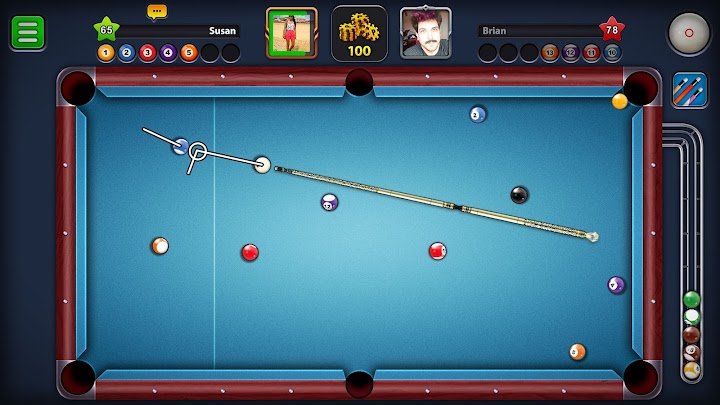
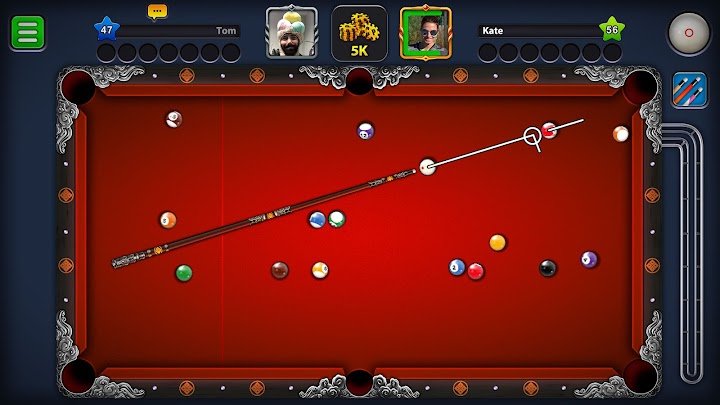
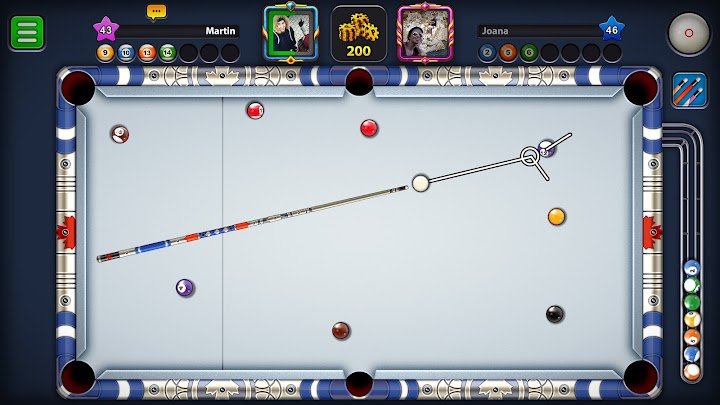
- Aim — drag to set the direction of the cue, using the guide lines.
- Choose power — pull back to set how hard the cue ball is struck.
- Apply spin — set the contact point on the cue ball to control what happens after impact.
- Shoot — release, and the physics takes over.
- Watch the cue ball — where it ends up determines whether you have a next shot at all.
The step most beginners ignore is step five. They aim at the object ball, pot it, and then discover the cue ball has rolled into a terrible position or straight into a pocket. Planning the cue ball's path is the difference between a one-ball run and a five-ball run.
Aim, Power and Spin: The Three Controls
Aiming
The game provides aiming guides that show the cue ball's path and, on some cues, a projection of the object ball's path. These guides are genuinely helpful, but they show the straight-line result of a centre-ball hit. Once you apply spin, the cue ball will not follow the predicted line after contact.
Practical aiming advice: aim using the ghost ball method — picture where the cue ball must contact the object ball for the object ball to travel to the pocket, and aim the cue ball at that point rather than at the pocket itself. This is the same technique used in real pool, and it is more reliable than trying to aim directly.
Power
Power affects two things: whether the object ball reaches the pocket, and where the cue ball ends up. Hitting too hard is one of the most common beginner errors, because the cue ball then ricochets off cushions and leaves a poor next shot.
Rule of thumb: use the minimum power that will reliably pot the ball. Softer shots leave the cue ball closer to where you hit it, which means better position for the next shot.
Spin (English)
Spin is the feature that separates decent players from good ones, and it is the one most players never learn properly.
| Spin Type | How to Apply It | What It Does |
|---|---|---|
| Top spin (follow) | Contact point above centre | Cue ball continues forward after contact |
| Back spin (draw) | Contact point below centre | Cue ball comes back toward you after contact |
| Left / right spin | Contact point left or right of centre | Cue ball curves on the cushion; alters rebound angle |
| Combination spin | Diagonal contact points | Combines follow/draw with side spin for positional play |
| No spin (stun) | Dead centre | Cue ball stops or travels straight after contact |
Why spin matters: it lets you pot a ball and still control where the cue ball goes. Without spin, you are at the mercy of the table. With spin, you can pot a ball into a corner pocket and leave the cue ball near the centre for a straightforward next shot — which is how runs are built.
Beginner-friendly approach: learn follow and draw first. Side spin is powerful but harder to control, and it is the main reason players miss easy shots because the cue ball swerves or rebounds unpredictably.
Tables and Coin Stakes
8 Ball Pool offers multiple match locations, each with its own entry stake and reward. The city-named tables function as difficulty tiers, and the pattern is consistent: higher stakes mean better opponents and bigger rewards, but also bigger losses.
| Table Tier | Character | What It Requires |
|---|---|---|
| Beginner tables | Low stakes, forgiving opponents | Nothing beyond a small coin balance |
| Intermediate tables | Moderate stakes, more consistent opponents | Basic spin control and fewer fouls |
| Advanced tables | High stakes, experienced players | Positional play, safety shots, bank shots |
| High-roller tables | Very high stakes, strong competition | Consistency, cue upgrades, a healthy coin bankroll |
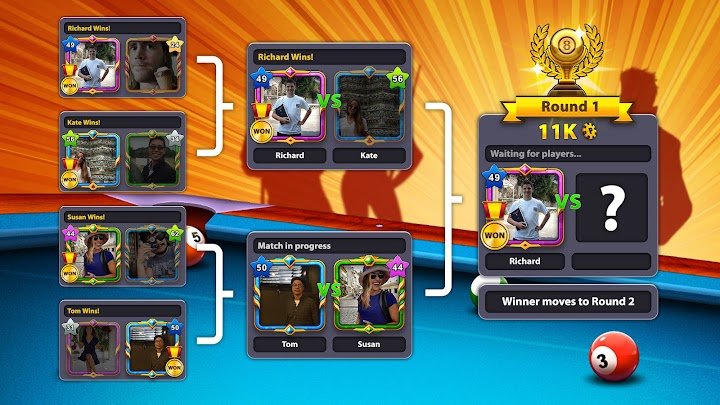
| Tournaments and events | Bracketed competitions with larger prizes | Winning several matches in a row |
The bankroll rule that matters: never stake a large proportion of your total coins on a single match. A sensible approach is to play tables where the entry stake is a small fraction of your balance, so a losing streak does not force you back to the beginner tables. Players who jump to high-stake tables as soon as they can afford the entry usually lose their balance quickly.
Note on stakes: entry costs and rewards change over time and vary by region and version. The current values are shown in the game itself, and it is better to check there than to rely on figures quoted in older guides.
Coins, the League and Ranking
Every competitive PvP match has coins at stake. Win, and you take the pot. Lose, and you lose your stake. This creates a genuine risk-and-reward loop that is more consequential than in most mobile games.
| System | What It Does |
|---|---|
| Coins | The core currency — staked in matches and spent on cues and items |
| League ranking | Rises and falls with results; determines matchmaking and access to higher tiers |
| Level system | Progresses with play and unlocks access to more match locations |
| Tournaments | Bracketed events where winning multiple matches yields larger rewards |
| Events and challenges | Time-limited objectives that award coins, boxes and cue pieces |
How matchmaking works in practice: the game matches you against players of a similar league ranking, which means you are generally facing opponents of comparable experience. That is good for fairness, and it also means you cannot rely on being better than your opponent — the deciding factor is usually who makes fewer mistakes.
The most common cause of a stalled climb is inconsistent risk management. Players win a few matches at a higher table, stake everything again, lose twice, and find themselves back where they started. Playing within your bankroll and grinding steadily beats gambling on high-stake matches.
Cues: Why the Stats Matter
Your cue is not cosmetic. Each cue has stats that directly affect play, and choosing the right one for your style is a genuine strategic decision.
| Cue Stat | What It Affects | Why It Matters |
|---|---|---|
| Aim | Length and detail of aiming guides | Better guides make difficult shots more readable |
| Force / power | Maximum shot strength | Helps with long shots and breaking |
| Spin | How much spin can be applied | More spin means better cue ball control |
| Time | How long you have to take your shot | More time reduces rushed mistakes on difficult shots |
Which stat matters most? For most players, aim and time are the highest-value stats early on, because they reduce mistakes. Spin becomes more important as you improve and start planning multi-ball runs. Force is useful but is the easiest to compensate for by choosing simpler shots.
Upgrading cues: cues can be upgraded using coins and cue pieces, and higher-level cues have better stats. Upgrading one good cue is generally better than spreading resources across many mediocre ones — the same principle as upgrading vehicles in other mobile games.
Do you need to pay for a good cue? No. Strong cues can be earned through progression, boxes and events, though paying accelerates access. A mid-tier cue with sensible play will beat a premium cue used without spin control.
In-App Purchases and Random Items
The game includes optional in-game purchases, including random items. This is worth understanding clearly, particularly if you are setting the game up for a younger player.
| Purchase Type | What It Typically Covers | Gameplay Impact |
|---|---|---|
| Coins | Currency for stakes and shop items | Indirect — better bankroll, not better skill |
| Cues | Directly purchasable or upgradeable cues | Stat improvements that do affect play |
| Boxes and randomised items | Cue pieces and rewards with unknown contents | Varies — spending is unpredictable |
| Cosmetics and table designs | Visual customisation | None |
The honest assessment: unlike purely cosmetic monetisation, 8 Ball Pool's paid cues do affect performance through their stats. That does not make the game pay-to-win in a simple sense — a skilled player with a basic cue beats an unskilled player with a premium one — but it does mean spending provides a real, if modest, advantage at the margins.
Random-item purchases are the part to be careful with. Buying a box that contains an unknown reward is a different decision from buying a specific item, because you cannot predict what you will get or what it will cost in total to obtain a particular cue. For a younger player, this is the mechanic most worth discussing or restricting.
If you want to control spending:
- Require authentication for every purchase rather than allowing a grace period after a previous one.
- Do not save payment details on a shared device.
- Review purchase history occasionally in your app store account.
- Set a spending limit where your platform provides one.
How to Improve: The Habits That Actually Work
| Habit | What It Fixes |
|---|---|
| Plan the cue ball, not just the pot | Ending a run because the cue ball is in a bad position |
| Use less power | Unpredictable cue ball rebounds after hard shots |
| Learn follow and draw before side spin | Missing easy shots because of uncontrolled curve |
| Avoid needless fouls | Handing your opponent ball-in-hand, which often loses the frame |
| Play safety shots when no pot is available | Forcing a low-percentage shot and losing the turn badly |
| Stay within your bankroll | Losing a coin balance in two matches and dropping back a tier |
| Practise bank shots | Being unable to pot anything when no direct line exists |
| Upgrade one cue rather than many | Spreading coins thin and having no strong cue |
Safety Play: The Underused Skill
When no pot is available, beginners often take a speculative shot and miss, handing the table to their opponent with a good layout. Strong players do the opposite: they play a safety shot that leaves the cue ball in a difficult place for the opponent, often behind a ball or against a cushion.
The principle: if you cannot pot, make sure your opponent cannot pot easily either. A well-played safety frequently forces a foul, which gives you ball-in-hand and often wins the frame.
Bank Shots
Bank shots use the cushion to reach a ball with no direct line to a pocket. They require understanding the angle of reflection, and the standard technique is to imagine a mirror image of the pocket across the cushion and aim at that point.
In-game tip: bank shots are easier with higher aim and spin stats, because the guides are longer and the cushion rebound is more predictable. If you find bank shots frustrating, it may be your cue rather than your judgment.
Account, Friends and Multiplayer
You sign in for free with a Miniclip or Facebook account, which lets you challenge friends directly from the game. Account choice has a practical consequence: a Miniclip account keeps your progress within Miniclip's system, while Facebook sign-in links your progress to that platform.
Practical advice: sign in with an account you will keep long-term, and enable whatever two-factor protection the account provider offers. Losing access to the linked account is the most common way people lose years of progress and coins.
Challenging friends works as a direct PvP match, and it is the most enjoyable way to play if you have a regular opponent. It removes the matchmaking variable and turns the game into a competitive rivalry rather than a grind.
Cheats, Hacks and Coin Generators
A significant proportion of search traffic around this game concerns cheats, aim hacks and free coin generators. It is worth being direct about this.
- "Free coin" and "coin generator" sites do not work. They are designed to collect account details, install malware or generate advertising revenue.
- Aim hacks and modded clients violate the terms of service and result in account bans, including loss of purchased content.
- Third-party apps offering coins are almost universally scams, and some are designed to steal login credentials.
- Legitimate coins come from matches, events, tournaments and purchases — nothing else.
The realistic path to more coins is bankroll management, steady play at tables you can afford, completing events, and improving enough that you win more than you lose. It is slower than the promises on scam sites, but it does not end with a banned account.
Tips for New Players
- Learn follow and draw spin first. They are the foundation of cue ball control, and side spin comes later.
- Plan where the cue ball ends up, not just where the object ball goes. Position is what builds runs.
- Use less power than you think you need. Hard shots scatter the cue ball unpredictably.
- Avoid fouls above all else. Ball-in-hand for your opponent loses frames.
- Play within your bankroll. Do not stake a large share of your coins on one match.
- Upgrade one cue properly. Aim and time are the most useful early stats.
- Use safety shots when no pot is available. Force your opponent to make the mistake.
- Learn the ghost ball aiming method. It is more reliable than aiming at the pocket.
- Complete events and challenges. They are the most reliable free source of coins and cue pieces.
- Link an account you will keep. Losing account access is the fastest way to lose everything.
- Ignore cheat and coin generator sites. They cost accounts and sometimes money.
Who Should Play 8 Ball Pool?
8 Ball Pool is a competitive puzzle game in sports clothing, and it suits players who enjoy thinking rather than reacting.
It is a strong fit if you:
- Enjoy pool, billiards or snooker and want a mobile version
- Like competitive PvP with a meaningful stake
- Prefer games where skill comes from understanding rather than reflexes
- Want short matches you can play in a few minutes
- Enjoy progression through cues, leagues and higher-stake tables
It may not be the right choice if you:
- Dislike games with coin staking and the possibility of losing progress
- Dislike in-app purchases and randomised item rewards
- Want an offline game — 8 Ball Pool requires a connection
- Become frustrated by opponents who are simply better
- Prefer casual, non-competitive mobile games
For parents, the game is a pool game with no violent content, but the coin staking, in-app purchases and random-item mechanics warrant attention. Purchases require authentication on most platforms, and that setting is worth confirming before a younger player uses the app.
Frequently Asked Questions
What is 8 Ball Pool?
8 Ball Pool is a 3D online pool game by Miniclip. You play one-on-one PvP matches against friends or matched opponents, with coins staked on the outcome. You aim with a cue, apply power and spin, and pot your group of balls before finishing with the 8-ball.
Is 8 Ball Pool free?
Yes. The game is free to download and play. It includes optional in-app purchases, including random items, which can be controlled through your device's purchase settings.
Do I need an internet connection?
Yes. 8 Ball Pool is an online multiplayer game and requires a connection to play matches.
How do I sign in?
You can sign in for free with a Miniclip account or a Facebook account. Use an account you intend to keep long-term, since your progress and coins are tied to it.
Can I play with friends?
Yes. You can challenge friends to direct PvP matches. This is often the most enjoyable way to play, because it removes matchmaking variance and turns the game into a rivalry.
How does the coin system work?
Each competitive match has an entry stake. Win and you take the pot; lose and you lose your stake. Coins are also spent on cues and shop items. Managing your bankroll — staking only a small fraction of your balance per match — is the key to climbing steadily.
What is the league and level system?
League ranking rises and falls with your results and affects matchmaking and access to higher tiers. The level system progresses with play and unlocks more match locations. Together they ensure you generally face opponents of similar experience.
Which cue should I use?
Early on, cues with strong aim and time stats are the most useful because they reduce mistakes. Spin becomes more valuable as you learn cue ball control. Upgrading one good cue is better than spreading resources across several.
Do paid cues make you better?
Paid cues have better stats and therefore provide a modest advantage, but skill matters far more. A skilled player with a basic cue will usually beat an unskilled player with a premium one.
What is the best way to aim?
Use the ghost ball method: picture where the cue ball needs to contact the object ball for the object ball to travel to the pocket, and aim the cue ball at that point rather than aiming directly at the pocket.
Why does my cue ball end up in a bad position?
Usually because of power and spin choices. Hard shots scatter the cue ball unpredictably, and without spin you cannot control where it goes after contact. Use the minimum power needed and learn follow and draw.
What is a safety shot?
A shot played when no pot is available, designed to leave your opponent in a difficult position rather than taking a low-percentage attempt. A good safety often forces a foul, which gives you ball-in-hand.
Are coin generators and cheats real?
No. Coin generator sites and aim hacks do not work. They are designed to steal account details, install malware or generate advertising revenue, and using modded clients results in account bans. Legitimate coins come from matches, events, tournaments and purchases only.
Does the game include random-item purchases?
Yes. The game includes optional in-app purchases, including random items such as boxes with unknown contents. This is worth understanding before spending, particularly on devices used by children.
How do I stop accidental purchases?
Require authentication for every purchase in your device settings, do not save payment details on shared devices, and review purchase history periodically in your app store account.
Is 8 Ball Pool suitable for children?
The game contains no violent content and is a pool simulation, so the content itself is broadly suitable. However, the coin staking, in-app purchases and random-item mechanics should be discussed or restricted before a younger player uses the app.
How do I contact support?
Support is handled through Miniclip's official channels, linked in the official resources section below.
Download and Availability
8 Ball Pool is a third-party game developed by Miniclip and distributed through the official app stores. Availability, in-app purchase options, table stakes and event content may vary by region and version.
Before installing, check the official marketplace listing for the latest version, device requirements and purchase information.
Official Resources:
- Miniclip: Miniclip Official Website
- Terms and Conditions: Miniclip Terms and Conditions
- Privacy Policy: Miniclip Privacy Policy
- Facebook: Miniclip on Facebook
- Instagram: 8 Ball Pool on Instagram
- TikTok: 8 Ball Pool on TikTok
- YouTube: 8 Ball Pool on YouTube
Final Thoughts
8 Ball Pool has lasted because it is a genuinely good game of angles disguised as a casual mobile app. The mechanics are simple to learn and deep enough that players with thousands of matches still have things to improve. The difference between a 40% win rate and a 60% win rate is rarely luck — it is spin control, cue ball planning, safety play and not handing away ball-in-hand.
The practical advice is short. Learn follow and draw before side spin. Use less power than feels natural. Plan where the cue ball ends up rather than only where the object ball goes. Avoid fouls above all else. Upgrade one cue properly rather than several badly. Stake only a small fraction of your coins per match, and let steady play do the work.
The practical advice for parents is equally short. Confirm that purchases require authentication, be aware that some purchases are randomised rather than specific, and talk to a younger player about coin staking before they develop strong opinions about high-stake tables.
And ignore the coin generator sites. They have never worked, and the accounts they cost are real.
Voyanta is an independent game discovery platform and is not affiliated with or endorsed by Miniclip. All 8 Ball Pool and Miniclip trademarks and related intellectual property belong to their respective owners.