- Developer
- Noodlecake
- Installs
- 1M+
- Downloads
- 0
- Views
- 1
- Updated
- Nov 6, 2026
Screenshots
About Getting Over It
Getting Over It with Bennett Foddy Complete Guide: Mechanics, Techniques and Whether You Should Try It
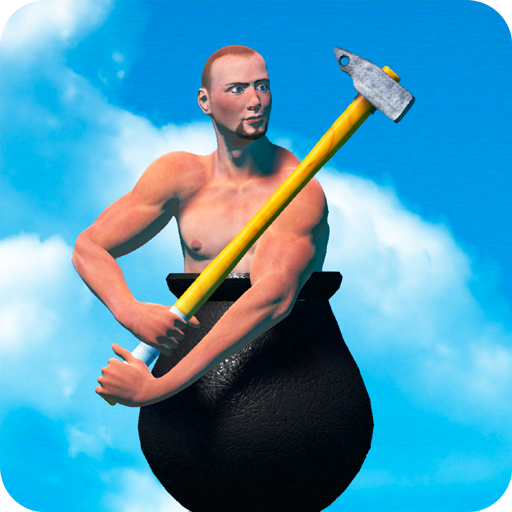
Getting Over It with Bennett Foddy is a punishing climbing game, and it is one of the few games that is honest about this in its own marketing. You control a man in a pot with a hammer, and that is the whole control scheme. With practice, you will be able to jump, swing, climb and fly. Without practice, you will fall.
The game is a homage to Jazzuo's 2002 B-Game classic Sexy Hiking, and it borrows that game's core idea almost exactly: a physics-driven climber with an awkward tool, an enormous mountain, and no assistance of any kind. What Bennett Foddy adds is narration — a running philosophical commentary about frustration, impermanence and the problem at hand — and a design that deliberately makes losing progress a central feature rather than a bug.
This guide explains how the physics actually work, what techniques experienced players use, why the progress-loss design is not as cruel as it first appears, how the mobile version compares with the original mouse controls, and who this game is genuinely for. It contains no spoilers about the summit.
Getting Over It at a Glance
| Feature | Details |
|---|---|
| Genre | Physics-based climbing game with a single continuous mountain |
| Developer | Bennett Foddy |
| Inspired by | Jazzuo's Sexy Hiking (2002), a B-Game classic |
| Player character | A man in a pot, with no legs, holding a hammer |
| Controls | Mouse movement on PC; touch drag on mobile. That is all |
| Save system | Progress is saved, but falls can undo large amounts of it |
| Median completion time | Roughly 5 hours among playtesters |
| Mean completion time | Effectively infinite — many players never finish |
| Difficulty | Extremely high, and intentionally so |
| Combat | None. The game's only opponent is the terrain and your own hands |
That median-versus-mean detail is worth pausing on, because it explains the entire game. A median of about five hours means half of the playtesters finished within five hours. A mean approaching infinity means the average is dragged upward by a large tail of players who never finished at all. The distribution is not a bell curve — it is a fast group and an endless tail.
How the Game Actually Works
One Hammer, No Legs
You do not control the character directly. You control the hammer, and the character follows through physics. The hammer head has collision, the character has mass, and the handle connects them like a rigid lever. Move the hammer into the ground and push, and the pot rises. Hook the hammer over an edge and pull, and the pot pivots upward.
Because you have no legs, you cannot simply walk. Every metre of upward movement is a small physical manoeuvre — a pivot, a swing, a flick, a balance correction. This is why the game feels strange for the first hour and natural after ten.
The Techniques You Will Eventually Learn
The game never teaches these. You discover them or you watch someone else discover them. The most useful ones:
| Technique | What It Does | When It Matters |
|---|---|---|
| Pogo | Push straight down with the hammer to bounce the pot upward | Flat surfaces, gaps too wide to swing across |
| Swing and release | Use momentum from a swing to launch the pot forward or upward | Crossing gaps, reaching distant ledges |
| Hook and pull | Catch the hammer on a ledge and drag the pot up over it | Vertical walls, overhangs, cliff edges |
| Balance correction | Small counter-movements to stop the pot tipping backwards | Narrow ledges, anything near a drop |
| The flick | A quick short motion to reposition the hammer without moving the pot much | Precision sections where a large move would be fatal |
| Edge catch | Deliberately hooking a lip to arrest a fall | Recovering from a mistake mid-climb |
The most important skill is not any of these individually. It is knowing when to stop pushing. A very large proportion of falls happen because a player kept climbing one section further than their current control allowed, rather than consolidating what they had.
The Mountain and Its Sections
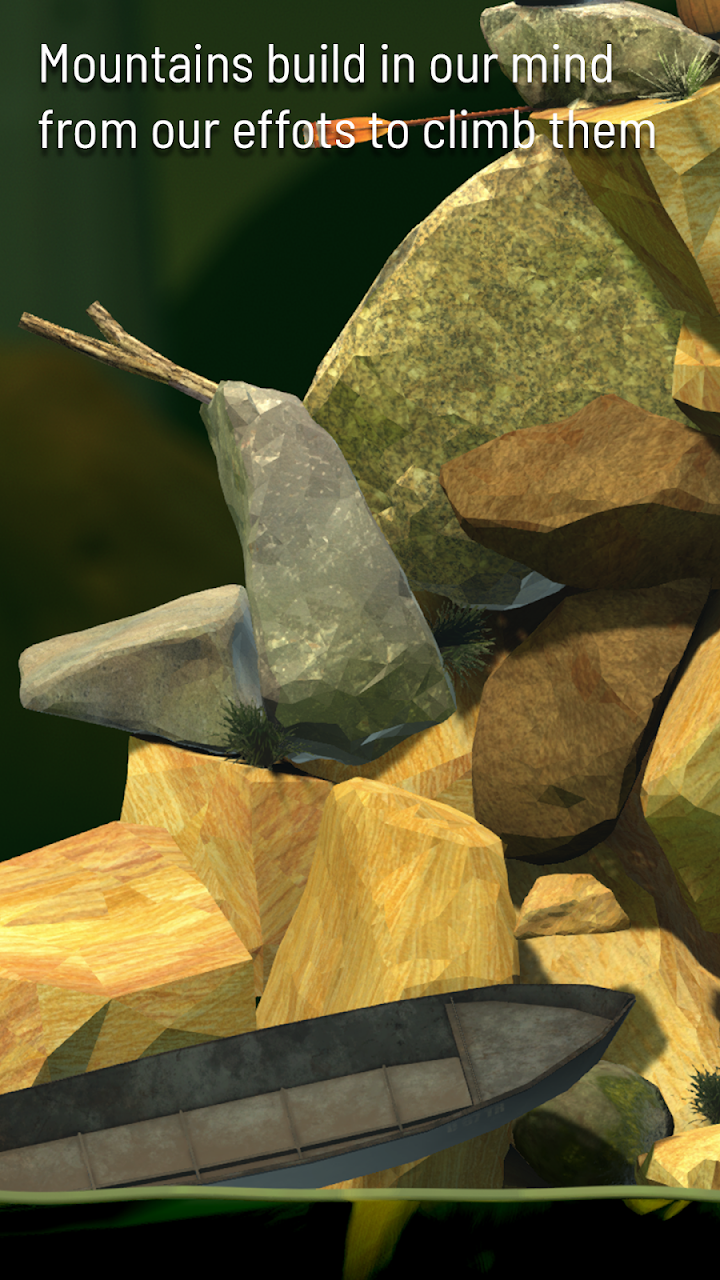
The mountain is not a natural landscape. It is built from an assortment of ordinary objects assembled into a vertical obstacle course — furniture, buildings, rocks, vehicles, vegetation and other recognisable things, stacked and arranged with no regard for realism. This is part of what makes it readable: you can identify what you are climbing even when it makes no sense that it is there.
Structurally, the mountain works as a series of escalating zones. Early sections teach the basic physics on forgiving geometry. Middle sections introduce narrow surfaces, moving elements and surfaces that are easy to slip from. Later sections combine everything and are genuinely hostile to small errors.
Reading the terrain is a skill in itself. Before committing to a move, experienced players identify:
- Where the hammer can safely hook
- Which surfaces are flat enough to pogo from
- Which direction gravity will pull the pot if the move fails
- Whether a fall here is recoverable or fatal to the run
The last point is the one that separates players who finish from players who do not.
Losing Progress Is the Design
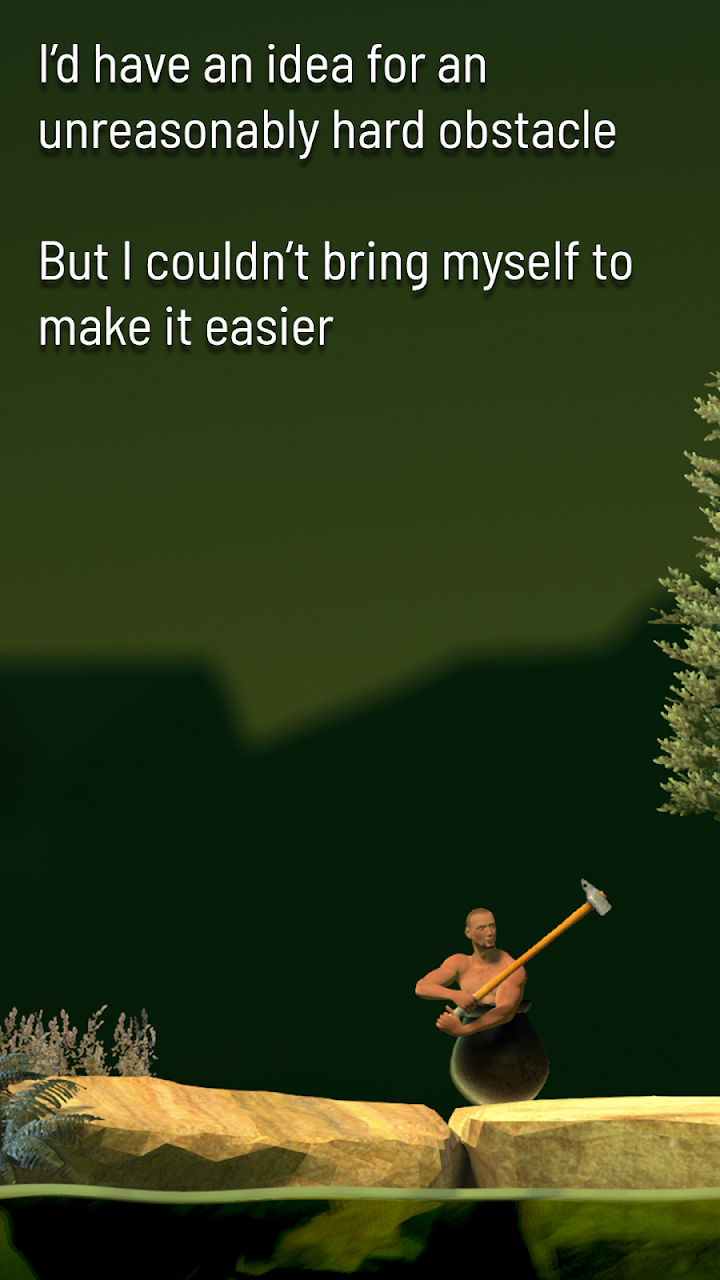
The game saves your position, but it does not protect it. A bad swing on a high ledge can send the pot tumbling back down through everything you just climbed. This is not a bug, an unfair trap or a failure of the save system. It is the entire point.
Foddy has been explicit that the game is designed to produce frustration, and the narration exists specifically to talk you through it. Between climbs you will hear him make philosophical observations about the problem at hand — about impermanence, about practice, about the difference between wanting to have finished something and wanting to do it.
Why this works better than it sounds: because there is no death, no enemy and no time limit, a fall is never a loss state. You can always climb again. What you lose is time and the assumption that you were safe. Many players report that their second climb through a section is faster and more confident than their first, which means the fall did not waste the practice — it consolidated it.
That said, this framing does not make the experience pleasant for everyone. Some players find the loss genuinely demoralising and stop. That is a reasonable response, and the game does not pretend otherwise. Its own description promises that you will "feel new types of frustration you didn't know you were capable of."
The Practical Strategy Against Falling
- Climb in stages. Treat each recognisable section as a checkpoint and stop pushing once you clear it.
- Secure first, advance second. Get the pot onto stable ground before attempting the next move.
- Never attempt a new manoeuvre above a long drop. Practise it on flat ground first.
- Take breaks after big falls. Frustration produces the exact imprecise inputs that cause the next fall.
- Accept a partial regain. If you fall two sections, climbing back quickly is usually easier than trying to take an aggressive shortcut.
Mobile vs PC: The Control Question
The game was designed around a mouse. On PC, you move the hammer by moving the mouse, and the precision of a mouse — small, continuous, fine-grained adjustments — is exactly what the physics reward.
The mobile version replaces the mouse with a touch drag. Functionally it is the same idea: your finger position maps to hammer position. Practically, there are real differences:
| Aspect | Mouse (PC) | Touch (Mobile) |
|---|---|---|
| Precision | Very high — small movements are easy | Good, but limited by finger size and screen size |
| Visibility | Cursor does not obstruct the view | Finger can cover the hammer at critical moments |
| Fine correction | Straightforward | Harder on small screens |
| Session length | Comfortable for long attempts | Hand fatigue is a real factor |
| Portability | Requires a desk or laptop | Playable anywhere |
Practical mobile advice: play on the largest screen you have access to, keep your finger low so it does not obscure the hammer head, and expect the precision sections to take longer than they would with a mouse. The mobile port is a genuine version of the game, not a stripped-down one, but it is a harder version of the same game for most players.
Who Is This Game For?
The game's own description states plainly that it was made for "a certain kind of person, to hurt them." That is a joke, but it is also accurate. This is not a game for everyone, and it is not pretending to be.
You will probably enjoy it if you:
- Enjoy learning physical systems through repetition rather than instruction
- Do not mind losing progress and find that motivating rather than crushing
- Like games with a strong authorial voice and a sense of humour about their own difficulty
- Have patience for a single, continuous challenge rather than varied content
- Have played and enjoyed other punishing precision games
You will probably dislike it if you:
- Play games to relax
- Become genuinely upset by losing progress
- Want a story, characters or variety of content
- Prefer games that teach you their mechanics clearly
- Have limited time per session and need reliable progress
There is also a middle group that is larger than either: people who play for a few hours, get about two-thirds of the way up, and stop. That is a legitimate way to experience the game, and it explains the mean completion time.
Tips for New Players
- Spend your first session deliberately failing. Practise the pogo and the swing on low, safe ground before you need them.
- Watch your hammer head, not the pot. The pot follows the hammer; the hammer is what you are controlling.
- Slow down on narrow sections. Precision sections are lost to speed far more often than to lack of skill.
- Do not climb while frustrated. Take a real break. The game is not going anywhere and your inputs will be worse.
- Learn to catch edges. Being able to arrest a fall is worth more than being able to climb faster.
- Listen to the narration. It is not just flavour — it is designed to reframe the frustration you are feeling at that exact moment.
- Use a large screen if possible. On mobile, a tablet makes the precision sections noticeably more manageable.
- Accept that a fall is practice. You have not lost the section; you have made the next attempt faster.
Frequently Asked Questions
What type of game is Getting Over It with Bennett Foddy?
It is a physics-based climbing game. You control a man in a pot with a hammer and climb a single enormous mountain made of assorted objects. There is no combat, no timer and no death — the only obstacle is the terrain and your control of the hammer.
How long does it take to finish?
Among the developer's playtesters, the median time was about five hours. The mean was much higher, close to infinite, because a large number of players never finish at all. In practice, completion time ranges from a few hours for experienced players to never.
Do you lose all your progress when you fall?
Not all of it, but potentially a very large amount. The game saves your position, but a fall can send you back down through multiple sections you have already climbed. Recovering from a fall is part of the intended experience.
Is there a save system?
Yes. The game saves your progress, and you can quit and return to your current position. The save does not protect you from falling — it simply records where you are.
Can you play it on mobile?
Yes. The mobile version replaces mouse movement with a touch drag. It is the same game, but precision sections are generally harder because a finger is less precise than a mouse and can obscure the screen.
Does it support a controller?
The game is designed around continuous pointer movement, which maps naturally to a mouse and to touch. It is not built around analogue sticks or buttons, and the control scheme is deliberately minimal.
Is the game unfair?
The physics are consistent and the terrain does not change. It is punishing but not random — every fall is caused by an input. Whether that counts as fair depends on your tolerance for precision challenge.
What is at the top of the mountain?
The game promises "great mysteries and a wonderful reward" for master hikers who reach the summit. This guide avoids describing it, because the ending is the payoff for the climb.
Is the narration necessary?
It is a core part of the game. Bennett Foddy talks you through the climb, offering philosophical observations about frustration, impermanence and practice. Many players consider it the element that makes the difficulty bearable.
Is it suitable for children?
The game contains no violence, no mature themes and no frightening content. However, its difficulty and the frustration of losing progress make it better suited to older players who can handle repeated failure calmly.
Is there multiplayer?
No. It is a single-player experience with one continuous challenge.
What is Sexy Hiking?
Sexy Hiking is a 2002 freeware game by Jazzuo that Getting Over It explicitly pays homage to. It uses a similar concept — a physics-driven climber with a hammer on a difficult vertical course — and Getting Over It credits it directly.
Should I buy it if I get frustrated easily?
Probably not, or at least not expecting to finish it. The game is deliberately built to produce frustration, and that is its stated purpose. Many players enjoy a few hours of it without ever reaching the top.
Download and Availability
Getting Over It with Bennett Foddy is a third-party game developed by Bennett Foddy and published on different platforms through its respective distribution partners. Mobile availability, pricing, compatibility and regional access may vary.
Before installing, check the official marketplace listing for the latest version, device requirements, purchase information and supported features.
Official Resources:
- Official Website: Bennett Foddy's Official Website
- Original Inspiration: Sexy Hiking (2002) — background on Jazzuo's original game
Final Thoughts
Getting Over It is a rare thing: a game whose difficulty is not a side effect of its design but the subject of it. The hammer physics, the legless pot, the mountain built from junk, and the narration about impermanence all point at the same idea — that the value of climbing something is in the climbing, not in having climbed it.
Whether that lands for you depends entirely on how you respond to losing twenty minutes of progress to a single bad flick. If the answer is "I want to try again immediately," this game was made for you. If the answer is "I want to close the app," it was also, in a sense, made for you — just not in a way you will enjoy.
Start on flat ground, learn the pogo before you need it, and stop climbing when you notice your hands getting tense. The mountain will still be there.
Voyanta is an independent game discovery platform and is not affiliated with or endorsed by Bennett Foddy or the game's publishers. All Getting Over It with Bennett Foddy trademarks and related intellectual property belong to their respective owners.