- Developer
- ustwo games
- Installs
- 5M+
- Downloads
- 0
- Views
- 1
- Updated
- Nov 6, 2026
Screenshots
About Monument Valley
Monument Valley Complete Guide: Impossible Architecture, Puzzles and Whether It Is Worth It
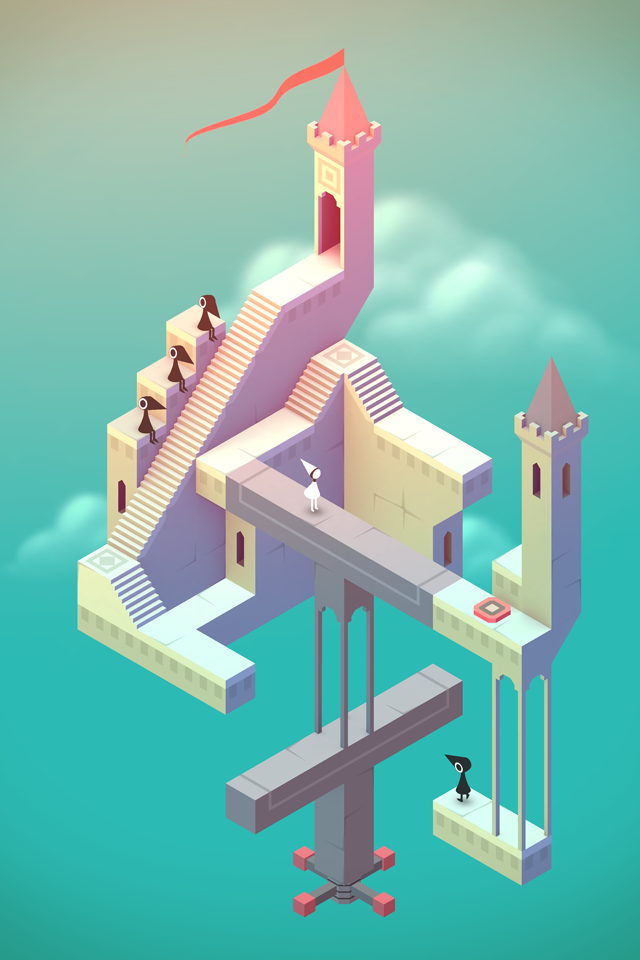
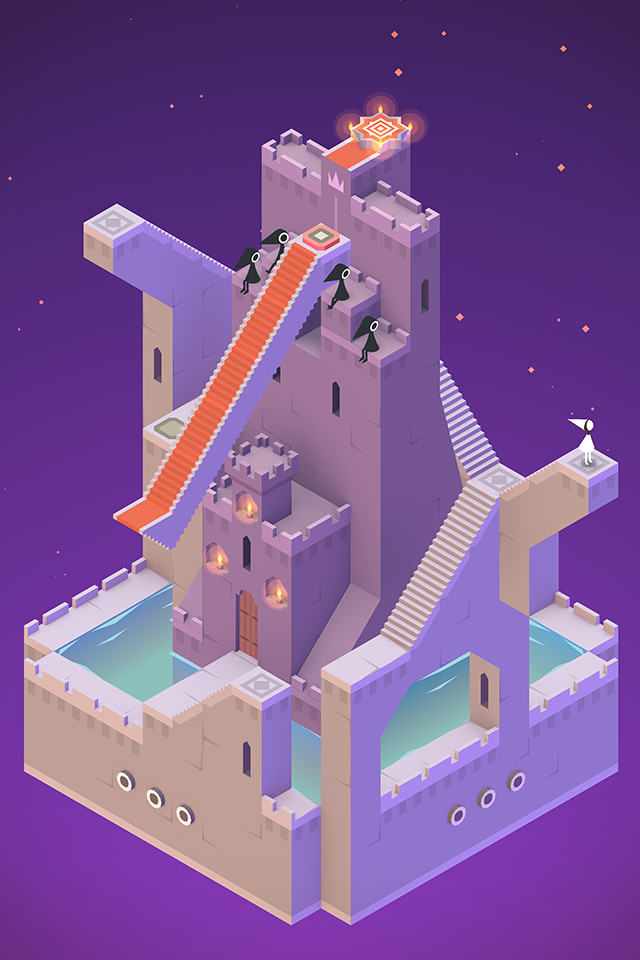
Monument Valley is a surreal exploration game built around fantastical architecture and impossible geometry. You guide the silent princess Ida through mysterious monuments, uncovering hidden paths, unfolding optical illusions and outsmarting the enigmatic Crow People.
It is also one of the shortest and most deliberately constructed games in the mobile space. A first playthrough of the base game takes roughly an hour, and that brevity is a design choice rather than a shortcoming. The puzzles are hand-made rather than generated, the art is hand-crafted rather than procedural, and the whole experience is built to be finished rather than played indefinitely.
This guide explains how the game actually plays, what each content package includes, what makes the puzzle design work, how the audio and cloud save features behave, and who is likely to enjoy it. It avoids story spoilers beyond the first few chapters.
Monument Valley at a Glance
| Feature | Details |
|---|---|
| Genre | Puzzle game built on perspective and optical illusion |
| Developer | ustwo games |
| Base game length | Roughly one hour, ten chapters |
| Expansions | Forgotten Shores (8 chapters) and Ida's Dream |
| Core interaction | Tap to move, twist and drag to reshape the world |
| Combat | None — the Crow People are obstacles, not enemies to defeat |
| Difficulty | Gentle. Designed to be completed by anyone |
| Cloud save | Yes, synchronises progress across devices |
| Best played with | Headphones, in a quiet room, without rushing |
The game has been widely praised in reviews — Kotaku described it as "one of the very finest hours, and the value of such a thing is incalculable," Polygon scored it 9/10, and Touch Arcade gave it 5/5 — and those quotes are a fair summary of what the game is selling: a short, polished, complete experience rather than a long one.
How the Gameplay Works
Two Actions, One Idea
Monument Valley asks almost nothing of your fingers. You can do exactly two things:
- Tap a path — Ida walks to that point if the route is reachable.
- Twist or drag the world — handles, cranks, sliding platforms and rotating rings move parts of the architecture itself.
That is the entire control scheme. The complexity comes from what those two actions do to the geometry around you, not from the inputs themselves. This is why the game is genuinely playable with one hand, on a small phone screen, on a commute.
Impossible Geometry as a Mechanic
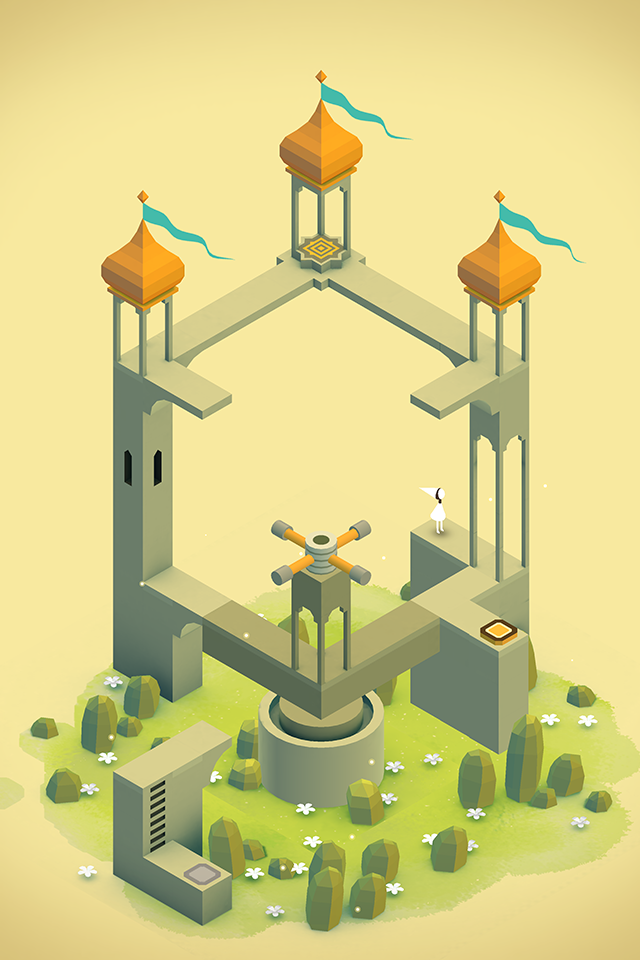
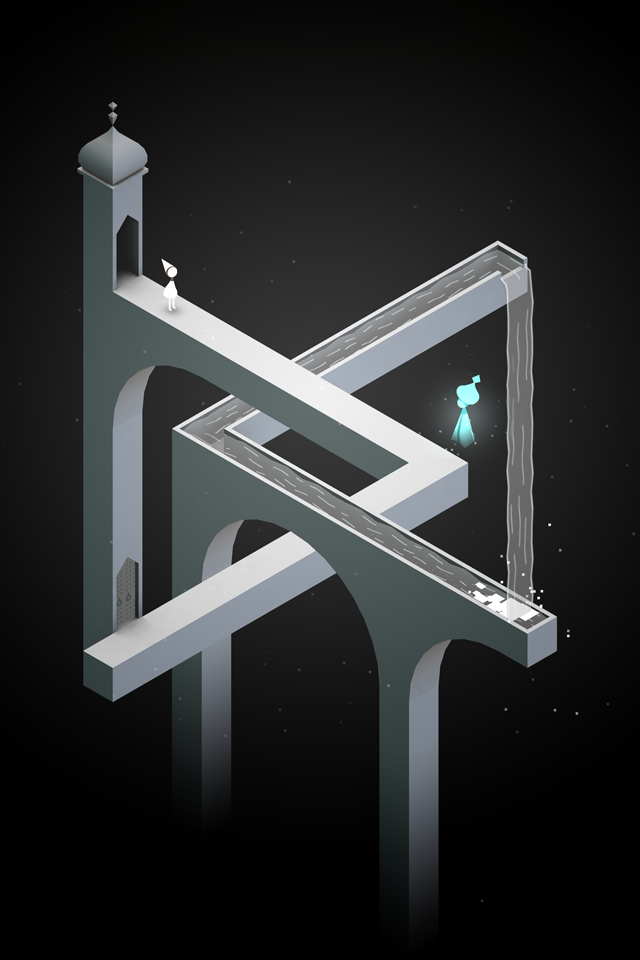
The defining idea is that the world does not obey consistent 3D rules. A path that appears disconnected in one view connects perfectly in another. Rotating a structure can turn two separate staircases into one continuous walkway. Walkways can fold into a flat plane and back out into a different arrangement.
The puzzles work because the game renders a fixed isometric perspective. What you see on screen is the truth, not the "real" three-dimensional arrangement behind it. Once you internalise that rule, the puzzles stop feeling arbitrary and start feeling fair.
Mechanic types you will encounter:
| Mechanic | What It Does |
|---|---|
| Rotating cranks | Turn part of a structure so a path aligns with another |
| Sliding platforms | Move a walkway horizontally or vertically to bridge a gap |
| Perspective locks | Two surfaces connect only when viewed from a specific angle |
| Crow People | Block Ida's path and require you to reroute or distract them |
| Totem | A friendly companion that enables paths Ida cannot reach alone |
| Sacred geometry | Collectible objects that unlock the exit of most chapters |
Why It Rarely Stumps You
Monument Valley is not a difficult game, and it is not trying to be. Almost every chapter can be solved by experimenting with the available handles and watching what changes. There is no fail state, no timer, no death and no penalty for trying something.
This is a deliberate choice with a real trade-off. Players who want to be genuinely stuck and then genuinely satisfied by the solution will find the game light. Players who want a beautiful object to move through at their own pace will find it perfectly calibrated. Most people fall into the second group.
Content Packages Explained
The game is split into three content packages, and this is the part most store listings explain poorly.
| Package | Content | How You Get It |
|---|---|---|
| Base game | Ten chapters following Ida's journey through the monuments | Included with the purchase |
| Forgotten Shores | Eight additional chapters of adventure and illusion | Available as a separate purchase |
| Ida's Dream | Additional story chapters continuing Ida's tale | Included as free additional content |
What should you buy? Start with the base game. If you finish it and want more — which is common, since it ends sooner than most people expect — Forgotten Shores is the natural next step and is roughly the same length as the base game. Ida's Dream is free and sits alongside the main story.
Important: availability and bundling of Forgotten Shores varies by platform and region. Some storefronts sell it as a separate expansion, and some versions bundle it in. Check the current listing for your device before assuming it is included.
Is It Really Only an Hour?
For a first, unhurried playthrough of the base ten chapters, yes — somewhere around an hour, maybe a little more if you stop to look at things. With Forgotten Shores and Ida's Dream added, the total comfortably exceeds two hours. Replay value comes from re-experiencing the chapters rather than from procedural variation or new solutions.
Whether that is good value depends entirely on what you want from a game. If you measure value in hours per currency unit, Monument Valley will feel expensive. If you measure it in how much of those hours you remember afterwards, it holds up unusually well.
Art, Design and Sound
Every Chapter Is a Hand-Built Set
The visual design is inspired by minimalist 3D design, optical illusions, and palaces and temples from around the world. Each monument is a unique, hand-crafted world to explore, with its own palette, palette transitions and architectural motifs.
The colour work is doing more than decoration. Chapters shift between warm desert tones, cool blues, teals and muted reds, and those palettes tell you which structures belong together. When a chapter changes colour mid-puzzle, it is usually signalling that the geometry has changed too.
Audio That Responds to You
The sound design reacts to your manipulation of the world, producing a soundscape that shifts as you rotate and slide structures. This is the feature most often overlooked, and it is the main reason the game is best experienced with headphones.
Practically speaking: the audio cues also give feedback. A mechanism that cannot move further sounds different from one that can. Players who play muted are missing a quiet hint system, not just atmosphere.
Mobile Features: Controls, Cloud Save and Tablet Support
| Feature | What It Means in Practice |
|---|---|
| Touch controls | Tap to move, drag and twist to reshape the world |
| Phone optimised | Runs well on small screens; designed for portrait-friendly play |
| Tablet optimised | Larger layouts suit the isometric perspective and multi-touch dragging |
| Cloud save | Synchronises your game across all your devices |
| Offline play | Fully playable without an internet connection once installed |
Cloud save is more useful than it sounds. Because the game is short, it is tempting to play in small bursts on a phone and then continue on a tablet at home. Cloud save makes that seamless, so long as you sign in with the same account on both devices.
Phone vs tablet: the game is genuinely comfortable on a phone, which is not always true of puzzle games built around spatial manipulation. A tablet gives you more room for dragging handles precisely, but the puzzles are not designed around small targets, so a phone screen does not create artificial difficulty.
Story and Tone (Spoiler-Light)
Ida does not speak, and the game has no dialogue. The story is told through the monuments themselves, through brief illustrated interludes between chapters, and through the presence of the Crow People, who obstruct rather than attack.
The base game's arc is about a journey and a theft, and the closing chapters reframe earlier events in a way that many players describe as the emotional high point. Forgotten Shores and Ida's Dream extend the story rather than repeating it.
It is worth saying plainly: this is not a combat game. The Crow People are not enemies you defeat. They are obstacles, and the solution is almost always to route around them or change the geometry so they no longer matter. If you are looking for action, this is not the game.
Tips for Getting the Most Out of It
- Play with headphones. The reactive audio is a real part of the experience, and the sound cues help you notice what has changed.
- Do not rush to finish. The game is short. Spreading it over several short sessions makes it last longer and suits the pacing.
- Collect the sacred geometry. These collectibles gate the exit in most chapters, so pick them up as you pass rather than backtracking.
- Rotate everything. When stuck, the answer is almost always a handle you have not tried turning, or a structure you assumed was fixed.
- Look at a puzzle from a different angle, literally. Perspective is the whole mechanic. If a path looks broken, try moving a structure until the two ends line up on screen.
- Accept the fixed camera. The game draws the world as a flat image from one viewpoint. Do not try to imagine the "real" 3D shape — trust what is on screen.
- Finish the base game before buying Forgotten Shores. The expansion assumes you already understand the visual rules.
- Check whether Forgotten Shores is bundled on your storefront, since availability varies by platform.
Who Should Play Monument Valley?
Monument Valley appeals to players who value design, atmosphere and a compact, complete experience. It is one of the better examples of a mobile game that respects your time rather than trying to monopolise it.
It is a strong fit if you:
- Enjoy puzzle games built around perspective and spatial reasoning
- Prefer short, polished experiences over long grinds
- Care about art direction and sound design
- Play in short sessions on a phone
- Want something calm and wordless rather than tense
It may disappoint you if you:
- Want puzzles that genuinely challenge you for extended periods
- Measure value strictly by hours per purchase
- Expect combat, fail states or competitive elements
- Prefer games with ongoing content and progression systems
Frequently Asked Questions
What type of game is Monument Valley?
It is a puzzle game built around impossible geometry and optical illusions. You tap to move Ida and twist or drag structures to create paths that appear to connect from a fixed isometric perspective. There is no combat, no timer and no fail state.
How long does Monument Valley take to finish?
The base game is roughly one hour across ten chapters. Forgotten Shores adds eight more chapters, and Ida's Dream adds further story content, bringing a full playthrough comfortably past two hours.
Is Forgotten Shores included?
It is available as a separate purchase in the base game, and bundling varies by platform and region. Check the current listing for your device to see whether it is included or sold separately.
Is Ida's Dream free?
Ida's Dream is additional story content rather than a paid expansion, and it is the content added after the game's original release. Availability depends on your platform version.
Is the game difficult?
No. It is designed to be easy for anyone to pick up, enjoy and complete. There is no penalty for experimenting, and most chapters can be solved by trying the available handles and watching what changes.
Does Monument Valley have combat or enemies?
No. The Crow People obstruct Ida's path but are never fought. Puzzles are solved by rerouting paths and changing the geometry rather than defeating anything.
Does it need an internet connection?
No. Once installed, the game is fully playable offline. An internet connection is only needed to download the game, receive updates, or use cloud save syncing.
What does cloud save actually do?
It synchronises your progress across all your devices, so you can start a chapter on a phone and continue it on a tablet using the same account.
Is it optimised for tablets?
Yes. It is optimised for both tablets and phones. A tablet gives you more room for precise dragging, but the game is comfortable on a phone screen.
Is Monument Valley suitable for children?
It is generally considered family-friendly. There is no violence, no dialogue and no fail state, and the visual design appeals to a wide age range. Younger children can often solve early chapters independently, though later chapters require abstract spatial reasoning.
Does it have multiplayer?
No. It is a single-player experience from start to finish.
Are there ads or recurring purchases?
The game does not use consumable purchases, microtransaction currencies or advertising. The only notable optional purchase is the Forgotten Shores expansion.
Download and Availability
Monument Valley is a third-party game developed by ustwo games and published on different platforms through its respective distribution partners. Mobile availability, pricing, compatibility and regional access may vary, and expansion content may be packaged differently between storefronts.
Before installing, check the official marketplace listing for the latest version, device requirements, purchase information and supported features — particularly whether Forgotten Shores is included.
Official Resources:
- Official Website: Monument Valley Official Website
- Developer: ustwo games
Final Thoughts
Monument Valley is best understood as a designed object rather than a content platform. Every chapter is hand-built, every palette is chosen, and the reactive audio ties the whole thing together. Nothing is padded, and nothing is left unfinished.
That makes it easy to recommend and easy to criticise, depending on what you want. If you want a puzzle game to occupy you for dozens of hours, this is not it. If you want an hour or two of something genuinely beautiful that you will still think about later, it is one of the better options on mobile — and the touchscreen controls mean the platform does not get in the way of the design.
Start with the base game, play it with headphones, and decide about Forgotten Shores when you reach the end.
Voyanta is an independent game discovery platform and is not affiliated with or endorsed by ustwo games or the game's publishers. All Monument Valley trademarks and related intellectual property belong to their respective owners.