
- Developer
- ConcernedApe
- Installs
- 5M+
- Downloads
- 0
- Views
- 2
- Updated
- Nov 6, 2026
Screenshots
About Stardew Valley
Stardew Valley Mobile Complete Guide: Everything You Need to Know Before You Start Farming
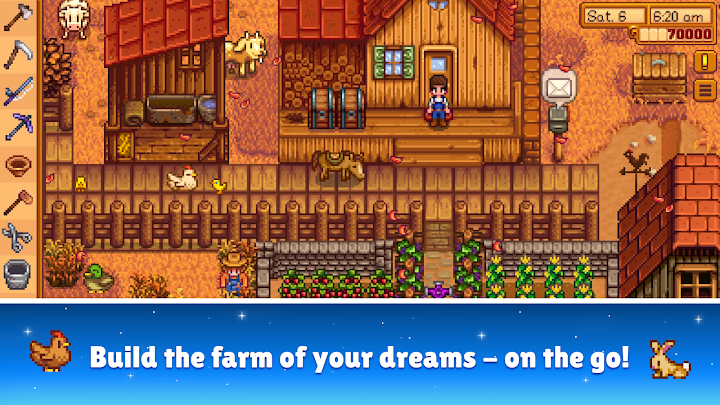
Stardew Valley brings the award-winning open-ended farming RPG to mobile devices, and it has become one of the most recommended paid games on Android. You inherit your grandfather's overgrown farm, move to the countryside, and slowly turn a patch of weeds into something that feels like home.
What makes the mobile version notable is that it is not a stripped-down spin-off. It is the same game, rebuilt for touchscreens, with the same 50+ hours of single-player content, the same 12 marriage candidates, and the same 1.4 update story content. What it does not include is multiplayer.
This guide explains how the game actually works, which decisions matter early, what the mobile controls feel like, what the 1.4 update added, and which beginner mistakes cost the most time. It is written for players who have not started yet, or who started and feel a little lost by the end of their first spring.
Stardew Valley at a Glance
| Feature | Details |
|---|---|
| Genre | Farming simulation with RPG, life-sim and dungeon-crawling elements |
| Developer | ConcernedApe (Eric Barone) |
| Playable content | 50+ hours for a first playthrough, considerably more for completionists |
| Farm maps | Six selectable layouts, each with different terrain and bonuses |
| Marriage candidates | 12 (six bachelors, six bachelorettes) |
| Skills | Farming, Mining, Foraging, Fishing, Combat |
| Mobile controls | Touchscreen, virtual joystick, external controller support |
| Multiplayer | Not supported on mobile |
| In-app purchases | None — one-time purchase |
The game received the Golden Joysticks' Breakthrough Award and was nominated for Game of the Year at the 2017 BAFTA Games Awards. Those accolades matter less than the practical question most new players ask: is it actually a good mobile game, or does the port feel compromised? The short answer is that the port holds up well, and the rest of this guide explains why.
How the Core Gameplay Loop Actually Works
Stardew Valley looks like a farming game, but it is really a time-management game with farming attached. Understanding the clock is the single fastest way to improve at it.
Each in-game day runs on a timer. You wake up at 6:00 AM, you have a limited energy bar, and most days end when you go to sleep. If you stay awake past midnight you lose energy, and if you collapse at 2:00 AM you lose money and part of the next day. Every action — tilling soil, chopping wood, swinging a sword, casting a fishing line — costs either time or energy or both.
That is why experienced players plan their days. A typical efficient day in early spring looks roughly like this:
- Water crops first, while you still have full energy.
- Check the TV for the weather forecast and the "Lucky Day" fortune.
- Spend the middle of the day on one focused task — mining, fishing, or clearing the farm.
- Visit town to talk to villagers and check shops before they close.
- Return home, store your harvest, and sleep before midnight.
The game is generous about this. Nothing is permanently missable in the sense of being locked out forever, but seasons do end. Crops that are not harvested before the season changes wither overnight, which is the first hard lesson most new farmers learn.
The Four Seasons and What They Change
| Season | Length | What Matters Most |
|---|---|---|
| Spring | 28 days | Rebuilding the farm, first crops, first friendships, Salmonberry season |
| Summer | 28 days | Highest crop income, Blueberry and Melon profits, Luau festival |
| Fall | 28 days | Cranberries and Pumpkins, the Stardew Valley Fair, Spirit's Eve |
| Winter | 28 days | No outdoor crops — mining, fishing, foraging and relationship building |
Winter surprises a lot of new players. You cannot grow normal crops outdoors, so it is the season to go deep into the mines, finish Community Center bundles that need fish or forage, and stockpile materials for spring.
Choosing Your Farm Map
This is the first real decision the game asks you to make, and it is permanent. You cannot change farm type after starting, so it is worth thinking about for a minute rather than clicking the first option.
| Farm Map | What It Offers | Best For |
|---|---|---|
| Standard | Largest open tillable area, minimal obstacles, a small pond | First playthroughs and players who want maximum crop space |
| Riverland | Split into islands by water, plenty of fishing spots | Players who enjoy fishing more than large-scale farming |
| Forest | Extra trees, seasonal forage spawning on the farm, respawning stumps | Foraging-focused players and anyone who wants steady early income |
| Hill-top | Cliffs, a quarry area, and a river running through the middle | Players who like mining and want ore access on their own land |
| Wilderness | Monsters spawn at night on the farm itself | Experienced players wanting extra combat and loot |
| Four Corners | Divided into four quadrants, each echoing another map's theme | Players who want variety, and the most flexible all-rounder |
Practical recommendation: if this is your first time, choose Standard or Four Corners. Riverland and Hill-top are charming but the reduced tillable space frustrates players who later decide they want a large farm. Wilderness is genuinely harder at night and is better saved for a second playthrough.
Skills and Progression Explained
Stardew Valley has five skills, each levelling from 1 to 10 through use. At levels 5 and 10 you choose a profession, and those choices shape your income far more than most new players realize.
| Skill | Levelled By | Why It Matters |
|---|---|---|
| Farming | Harvesting crops, tending animals | Unlocks crafting recipes and boosts crop and animal product value |
| Mining | Breaking rocks in the mines | More ore per node, faster mining, access to better tools |
| Foraging | Picking up wild items, chopping trees | Better forage quality, extra wood and sap, crafting unlocks |
| Fishing | Catching fish, crabs and trash | Easier fishing bar, higher value catches, treasure chances |
| Combat | Defeating monsters in the mines | More HP, better weapon handling, combat-related recipes |
A useful rule of thumb for professions: choose the money-focused branch (Rancher, Miner, Gatherer, Fisher, Fighter) if you want straightforward profit, and the utility-focused branch (Tiller, Geologist, Forester, Trapper, Scout) if you prefer smoother gameplay and critical-hit or resource bonuses. Neither is wrong, but the crop-value professions tend to pay off fastest.
Making Money in Your First Year
New players usually ask one question: how do I stop being broke? The honest answer is that year one is about building infrastructure, not getting rich.
Reliable early income sources, roughly in order of how soon they become available:
- Foraging and selling wild items — zero cost, and the Forest farm makes it stronger.
- Fast-growing crops — Parsnips in spring, then a mix of repeat-harvest crops like Blueberries in summer and Cranberries in fall.
- Fishing — the highest early-game income per hour if you can tolerate the minigame. River and ocean fish sell well, and Treasure Chests occasionally contain useful gear.
- Mining and selling ore — copper, iron and gold all sell, and the mines also produce gems.
- Artisan goods — once you have a Preserves Jar or Keg, turning crops into jam or wine multiplies their value substantially. This is the real turning point for farm income.
One tip that saves a lot of frustration: do not sell everything immediately. Keep a stash of common crops, forage and fish in a chest. Community Center bundles frequently ask for items you already threw away, and re-farming an out-of-season crop means waiting a full year.
Relationships, Marriage and Family
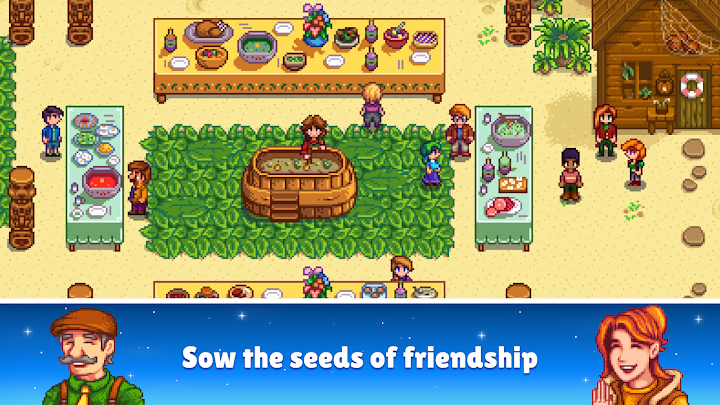
Stardew Valley is as much a social game as a farming one. Every villager has a friendship meter, and most have heart events that unlock as you get closer to them.
You raise friendship by talking to people daily and by giving gifts they like. Giving a gift a villager loves can be worth several days of conversation, while giving one they hate actively damages the relationship. Two gifts per week per villager is the maximum that counts toward friendship.
There are 12 marriage candidates — six bachelors and six bachelorettes — and each has a distinct personality and a ten-heart romance arc. To marry someone you need to reach ten hearts, give them a Bouquet once you reach eight hearts, and propose with a Mermaid's Pendant. After marriage, your spouse moves in, contributes to the farm in small ways, and you can eventually have children.
Friendships are not just romantic. Non-marriage villagers send gifts in the mail, unlock recipes, and some are required for specific quests and Community Center progress.
Community Center or JojaMart?
Early in the game you are given a choice that shapes your entire playthrough. The Community Center route asks you to complete bundles of items — crops, fish, forage, minerals, animal products — spread across several themed rooms. It is slower, more varied, and generally considered the intended experience.
The JojaMart route lets you simply buy the same repairs with gold through a membership. It is faster if you are good at making money, and it is a legitimate alternative, not a "wrong" choice. Many players do the Community Center route on their first file and Joja on a later one to see the difference.
Mining and Combat on Mobile
The mines are a 120-level dungeon beneath the mountains, with a checkpoint every few floors and better ore the deeper you go. Combat is real-time: you swing a sword, dodge slimes and bats, and use the elevator to return to floors you have already cleared.
Mobile adds an auto-attack option that swings your weapon automatically at nearby enemies. It is genuinely useful for casual mine runs, though it is less precise than manual control when you need to kite a group. If you plan to push deep into the mines or attempt the desert dungeon, manual attack with a controller is more reliable.
Practical mine advice: bring food for healing rather than relying on health regeneration, use staircases to skip floors you dislike, and never enter the mines without a weapon upgrade if you can help it.
Fishing: The Minigame Everyone Struggles With
Fishing is the most divisive system in the game. You cast, wait for a bite, then play a small bar minigame where you keep a green box over a moving fish icon. It takes a few in-game days to click, and the early bamboo pole makes it harder than it needs to be.
Two things make it much easier: buying a better rod as soon as you can afford one, and using bait once you unlock it. Training Rods are also available from Willy early on and make the bar larger, which is a legitimate way to level fishing before switching to a real rod.
On touchscreens, tapping to raise the bar works well once you adjust, but many players prefer a controller for fishing specifically.
Mobile-Specific Features and Controls
The mobile port was rebuilt for touchscreens rather than emulated, and it shows. The interface includes mobile-only conveniences that change how the game feels compared with PC or console.
| Feature | What It Does |
|---|---|
| Auto-select tool | Toggles quickly between your farming tools so you are not opening the inventory constantly |
| Auto-attack | Automatically swings your weapon at nearby monsters in the mines |
| Auto-save | Saves progress without requiring a manual save action |
| Touchscreen controls | Tap-to-move and tap-to-interact, with on-screen buttons for tools and actions |
| Virtual joystick | Optional on-screen stick for direct movement control |
| External controller support | Bluetooth gamepads supported for a more traditional control scheme |
Which control scheme should you use? Touchscreen plus auto-select is the most comfortable for general farm chores and town visits. A controller is noticeably better for mining, combat and fishing, where precision matters. Many players switch between the two depending on the task, and the game allows it.
What the 1.4 Update Added to Mobile
The mobile version includes the 1.4 update's single-player story content. If you last played Stardew Valley on mobile before that update, or you are comparing it to older descriptions, here is what changed:
- New town upgrades — community improvements that visibly change Pelican Town.
- Dating events — additional romantic cutscenes for each marriage candidate.
- New crops — extra crop varieties to grow across the seasons.
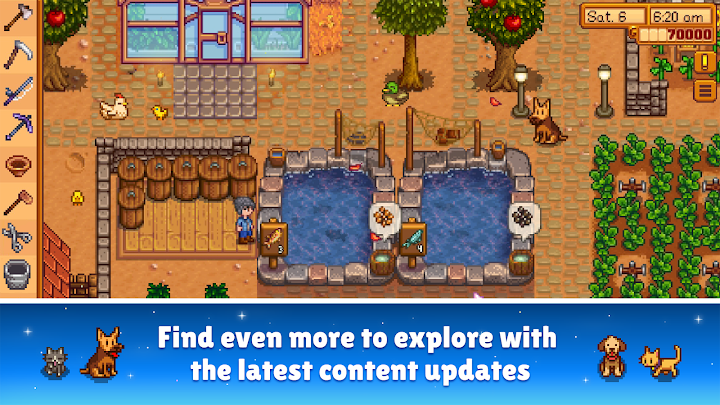
- Fishing ponds — raise fish on your own farm for passive production.
- New hats and clothing — expanded farmer customization.
- New pets — additional pet options beyond the starting dog or cat.
These additions round out the single-player experience considerably. The fishing pond in particular gives players a low-maintenance income source that fits neatly into a busy daily schedule.
What Is Not Included on Mobile
It is worth being clear about the limitations, because a lot of store listings and older articles are vague about them.
- No multiplayer — co-op farming, which exists on PC and consoles, is not available on mobile.
- No in-app purchases — the game is a single purchase, with no microtransactions, no ads and no paid expansion packs.
For a lot of players, those two facts are exactly what makes the mobile version appealing. It is a complete, self-contained game.
Tips for New Players
Getting Started Right
- Do not rush — Stardew Valley rewards patience. There is no penalty for taking your time, and no way to permanently lose access to content by going slowly.
- Plant something on day one — every day without crops planted is potential profit lost. Parsnips are cheap and grow quickly.
- Clear your farm gradually — you do not need to clear everything at once. Work area by area and keep paths open.
- Talk to everyone you pass — early friendship building pays off later, and conversations are free.
Money-Making Priorities
- Fish early and often — fishing provides reliable income with minimal upfront investment.
- Mine regularly — ore is needed for tool upgrades, and tool upgrades save enormous time later.
- Focus on one or two crop types per season — spreading thin across many crops reduces profit and complicates watering.
- Save for tool upgrades — upgraded tools use less energy and work faster. The watering can and pickaxe are the highest priority.
Efficiency and Energy
- Food is essential — cook or buy food to restore energy. Field Snacks made from tree seeds are a free early option.
- Keep a chest near the mines — you can drop off ore and gems instead of carrying everything home.
- Check the weather forecast — on rainy days you do not need to water crops, which frees the entire morning for mining or fishing.
- Use the journal and quest board — small early rewards add up, and some unlock recipes you cannot get any other way.
Who Should Play Stardew Valley?
Stardew Valley appeals to players who enjoy open-ended gameplay, gradual progression, and creative construction. It is equally suited to players who want a relaxing routine and to players who want to optimize and min-max their farm's output.
The game accommodates a wide range of playstyles:
- Builders and decorators — hundreds of customization options and farm layouts to design.
- Optimizers — crop profit margins, artisan goods chains, and skill professions reward careful planning.
- Explorers — the mines and the desert dungeon offer combat progression and rare loot.
- Story and relationship players — 12 marriage candidates, plus dozens of villagers with their own arcs.
- Casual mobile players — auto-save and touchscreen controls make short sessions practical.
Players who primarily want competitive multiplayer or fast action combat may find the pace slower than they expect. The game's appeal comes from accumulation rather than adrenaline.
Frequently Asked Questions
What type of game is Stardew Valley?
Stardew Valley is an open-ended farming RPG. It combines crop and animal farming, crafting, relationship building, exploration, fishing and real-time combat into a single game driven by a seasonal calendar.
Is Stardew Valley a full game on mobile, or a simplified version?
It is the full game, rebuilt for touchscreens, and includes the 1.4 update's single-player story content. The main omission is multiplayer, which is not supported on mobile.
Does Stardew Valley mobile have in-app purchases or ads?
No. It is a one-time purchase with no in-app purchases, no microtransactions and no advertising.
Does Stardew Valley mobile support multiplayer?
No. Multiplayer functionality is not supported on the mobile version. Single-player content is complete.
Can you use a controller with Stardew Valley on mobile?
Yes. External Bluetooth controllers are supported alongside touchscreen controls and an optional virtual joystick. Button customization is available where supported.
How many marriage candidates are there?
There are 12 marriage candidates — six bachelors and six bachelorettes — each with their own personality, gift preferences and heart events.
Which farm map should a beginner choose?
Standard is the safest choice for a first playthrough because it offers the most open farming space. Four Corners is also a good all-rounder if you want more variety.
How long does Stardew Valley take to finish?
A first playthrough typically runs 50+ hours. Players pursuing full completion — all Community Center bundles, all relationships, and endgame content — often spend well over 100 hours. The game has no fixed ending point.
Can you play Stardew Valley offline?
Yes. The mobile version is fully playable offline in single-player mode. An internet connection is only needed to download the game and to receive updates.
Is Stardew Valley suitable for children?
The game contains mild cartoon combat in the mines and some mature relationship themes, but no graphic content. Younger players may need help with the crafting and calendar systems.
Download and Availability
Stardew Valley is developed by ConcernedApe and published on mobile platforms through its distribution partners. Mobile availability, pricing, compatibility and regional access may vary.
Before installing, check the official marketplace listing for the current version, device requirements, purchase information and supported features.
Official Resources:
- Official Website: Stardew Valley Official Website
- Official Forums: Stardew Valley Forums
- Official Wiki: Stardew Valley Wiki
Final Thoughts
Stardew Valley's staying power comes from how well its systems fit together. Farming funds tool upgrades, tool upgrades make mining easier, mining produces materials for artisan equipment, and artisan goods fund the buildings that support animals and relationships. Nothing exists in isolation, which is why the game keeps pulling players back for "one more day."
On mobile, the touchscreen interface and auto-save make short sessions genuinely practical, while controller support keeps longer play sessions comfortable. The absence of multiplayer is the one meaningful gap, and for many players that trade-off is acceptable in exchange for a complete, ad-free, one-time-purchase game.
Start small. Plant a few parsnips, build a chest, talk to the people you pass, and let the first season teach you the rhythm. The farm will still be there tomorrow.
Voyanta is an independent game discovery platform and is not affiliated with or endorsed by ConcernedApe or the game's publishers. All Stardew Valley trademarks and related intellectual property belong to their respective owners.